In a summary of programmatic document which has almost 500 pages, the European Commission highlights the Romanian government commitment to develop the country and the money allocated to each of the 11 thematic objectives (OT) and operational programs.
Development directions of Romania
Commission shows that EU funds next seven years "will mobilize additional public and private funding for growth and jobs and reduce regional and social disparities existing in Romania."
Investments will be directed to several objectives:
- stimulation of innovation and the competitiveness of enterprises to increase their added value,
- boost growth and job creation
- improving research and innovation system performance, including the quality of higher education, cooperation with the business sector and private investment.
- development and increasing agricultural potential currently highly focused on low value-added activities,
- supporting the restructuring of farms and providing the necessary labor from other sectors competitive.
- support public access to the labor market and improve its skills to combat youth unemployment
- improving education and training systems in order to ensure a better match between skills and labor market needs, especially in terms of tertiary education and the vocational
- emphasis on the education and care of young children, the primary and secondary education, especially in disadvantaged communities, including the Roma minority.
Health will also benefit from its strong support:
- will be targeted disadvantaged communities and promote an alternative to hospitals, including primary health care facilities and ambulatory or e-health services.
- transition from institutional structures to Community Led solutions for children, the elderly and people with disabilities.
Romania's goals also seeks
- improving the quality of national government structural reforms
- expansion and modernization of the transport infrastructure of Romania, in agreement with the general plan for the future that will outline existing network by 2030.
- investment in waste, water and wastewater for the purposes of compliance with environmental requirements.
Regarding Romania's rural areas, farmers will receive assistance to develop or restructure their businesses and the diversification of economic activities will reduce excessive dependence on agriculture currently exists and will improve the prospects for job creation in rural areas.
Poverty in rural areas will be tackled through investment in upgrading infrastructure and improving access to basic services in order to improve the quality of life in rural communities and creating preconditions for local development.
Fisheries and aquaculture in Romania, investments will be directed towards projects that limit the impact of fisheries on the marine environment, with new forms of income, and diversify and add value to fisheries and aquaculture products.
Targets of Romania
European money received by our country must lead to measurable results, as they have taken the authorities in Bucharest. European Commission warns of of their existance and grouped them into several categories:
Europa 2020 goals:
- more than € 1 billion for research and development (R & D) and innovation (OT1), in support of achieving the national target of 2% of GDP invested in R & D (compared to 0.49% in 2012);
- a more energy efficient, € 3.9 billion will be invested to support the transition to a low carbon economy (OT4), including wider expansion of renewable energies (target of 24% );
- a substantial effort in terms of social inclusion (OT9) being allocated € 3.4 billion to combat severe social challenges facing Romania, and to support target of 580 000 the number of people at risk of poverty or exclusion (compared with 2008);
- increasing labor market participation (OT8), with a particular emphasis on young people in achieving their target employment work 70% nationally (benefiting € 2.2 billion);
- helping to reduce early school leaving rate to 11.3% and increasing participation in tertiary education by 26.7% (OT10), through an investment of 1.65 billion.
Obligations under the Treaty of Accession
Further development of water and wastewater services.
in this regard are allocated over € 3 billion in OT6 ensuring compliance with standards agglomerations with over 10 000 inhabitants and contributing substantially to upgrading agglomerations with more than 2,000 people;
Boosting national competitiveness:
- further development of the national network of broadband services and next generation access (NGA) through OT2 and LEADER, with a minimum rate of 30 Mbps, especially in rural areas, addressing the same problem of low subscription rate measures appropriate (training, e-services, e-government) in all priorities;
- increased productivity and value added in the agriculture, fisheries and aquaculture, encouraging the participation of young farmers and fishermen;
- increase the competitiveness of operators and the survival rates of young SMEs, through direct support and financial engineering schemes within OT3;
- further consolidation of facilities and transportation network reliability being allocated for this purpose 20% of the funds in the OT7 ESI in order to increase accessibility and attractiveness of the regions industrial investment;
- resolving administrative deficiencies systemic reforms in the governance and administration in this respect being allocated € 800 million.
Romania has 30.6 billion euros, half of them directed to the economical competitiveness.
The funds allocated to Romania are worth 30.6 billion euros in 2014-2020. Approximately € 22.4 billion are in cohesion policy (ERDF, ESF, Cohesion Fund), plus another € 106 million in employment initiative among young people (with an identical allocation of ESF).
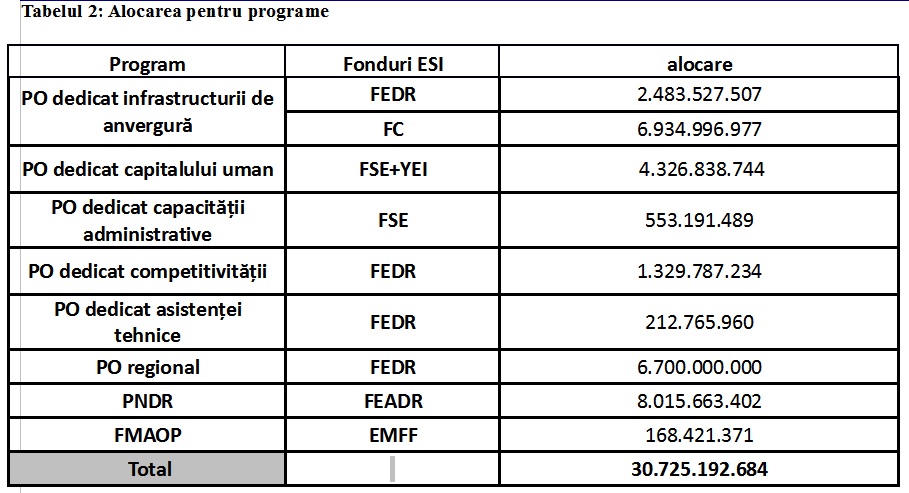
Funding for the development of agriculture and rural areas will be supplemented by € 8 billion from European Agricultural Fund for Rural Development (EAFRD). Allocation for the European Maritime and Fisheries (EMFF) amounts to approximately € 168 million. Details of the assignment are shown in the table below.
Romania has chosen to fund investments in all of the 11 thematic objectives defined in the EU regulations.
Romania will target 51.2% to research and development (OT1), information technology (OT2), competitiveness (OT3) and low-carbon economy (OT4), with € 5.5 billion more than the minimum required.
Significant resources are directed to OT4 (low carbon economy) in this respect is reserved € 3.25 billion, representing 30% from the European Regional Development Fund and more than the minimum required, largely from the support expected thermal rehabilitation of buildings.
Share ESF structural funds amounting to 30.8%, or around € 4.8 billion: 23% of the money is earmarked for social inclusion and combating poverty, above the 20% minimum required.
EAFRD (39% of total allocations) are directed to a large extent to biodiversity and sustainable land management to climate change mitigation in agriculture and forestry and adaptation (in the OT 4, 5 and 6), and the competitiveness of the agriculture and the food processing (29% in the OT3).
Distribution of money on the 8 operational programs
European money will be spent through eight OPs, which have been allocated the following amounts:
- Competitiveness Programme aiming thematic objectives 1 and 2 – 1,329 billion euros
- Program scale infrastructure (transport, environment and energy), financed by the ERDF and the Cohesion Fund, the thematic objectives 6 and 7 – 9,418 billion euros
- Programme (ERDF), which addresses the needs of regional and local (within the thematic objectives 1, 3, 4, 6, 8 and 9) – 6,700 billion
- Technical Assistance Programme (ERDF), which supports the management of funds – 0.212 billion euros
- Human Capital Programme (ESF) within the thematic objectives 8, 9 and 10, which address the priorities of the employment, education and social inclusion – 4.326 billion euros
- Programme Administrative Capacity (ESF) within the thematic objective 11, which deals with administrative reform and support for public institutions – 0.553 billion euros
5 reasons why you can become an Add-Energy Renewable Romania PARTNER
To register your Company as ADD ENERGY PARTNER , please access 
For other informations click to 